Trending...
- The Golden Jazz Fest Shuttle Returns for 2026
- KeysCaribbean Resorts Offer Savings On Vacations Through Aug. 31, Preview Exceptional Select Fall Rates of Less Than $200/Night
- 5.6 Million EUR in Q1 Project Awards for Integrated IoT Solutions / Data Analytics Subsidiary of Smart City Developer: Affluence (Stock Symbol: AFFU)
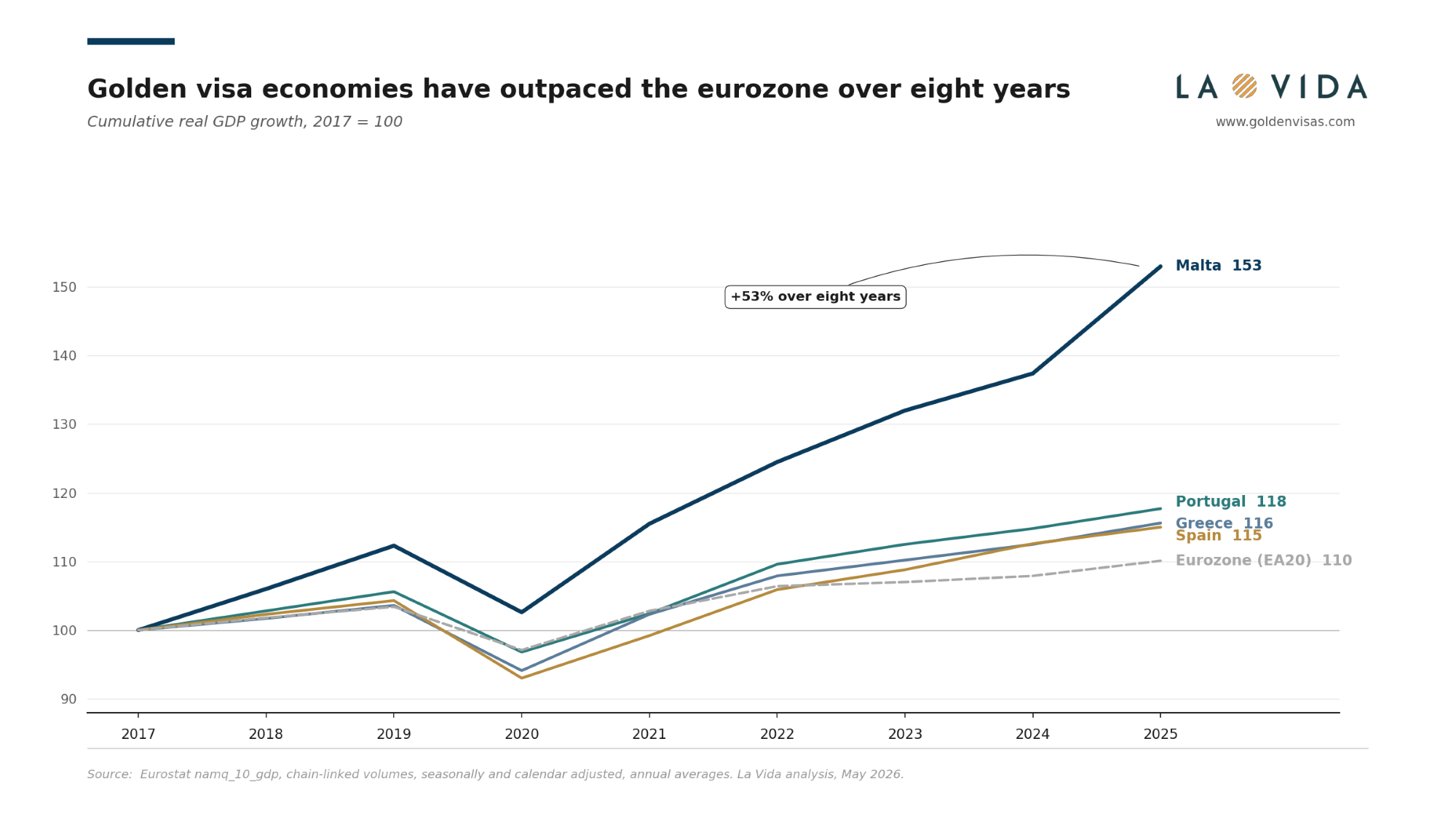

Real GDP in Malta, Portugal, Greece and Spain grew faster than the eurozone average from 2017 to 2025, according to research published today by investment migration firm La Vida. The four economies — all of which operated investment migration programmes throughout the period — outperformed the bloc on both aggregate and per-capita measures.
UXBRIDGE, U.K. - PrAtlas -- LONDON — The four European countries that ran continuous investment migration programmes from 2017 to 2025 each grew faster in real GDP terms than the eurozone average, new analysis from UK-based investment migration advisory firm La Vida has found.
Drawing on official Eurostat national accounts data, the research shows Malta's economy grew 53% in real terms over the eight years, Portugal by 17.7%, Greece by 15.6% and Spain by 15.0%. The eurozone aggregate over the same period grew 10.1%.
The pattern holds when adjusted for population. On a real GDP-per-capita basis, Malta grew by 22.4%, Greece by 19.3%, Portugal by 12.9% and Spain by 8.8%, against a eurozone figure of 7.7%.
More on PrAtlas
Direct investment associated with the programmes themselves is too small to account for the difference. La Vida estimates the qualifying investment generated by the four programmes sits in the range of 0.025% to 0.25% of national GDP per year — an order of magnitude or more below the size of the growth gaps observed.
Paul Williams, CEO and Founder of La Vida, said:
"European economies are struggling for growth while government debt continues to climb. Governments and the EU need to take a closer look at the role residency and citizenship by investment can play in attracting productive wealth into their economies. Our analysis doesn't prove the programmes drove the growth gap. But the direction of the data is hard to ignore, and the contribution of wealthy migrants extends well beyond their initial qualifying investment — through businesses they start, taxes they pay over time, and capital they go on to deploy."
La Vida research identifies three non-exclusive readings of the data. Direct investment under the programmes contributed to growth through real estate, construction, government revenue and associated multiplier effects, but at a modest scale. A second channel runs through the entrepreneurial behaviour of programme beneficiaries themselves — investment beyond the qualifying minimum, business formation, employment creation and tax contributions over time. A third reflects shared characteristics across the four economies that drove growth independently of investment migration policy, including post-pandemic tourism recoveries, EU recovery fund allocations, services exports and recovery from the post-2012 sovereign debt crisis.
More on PrAtlas
The European investment migration landscape has shifted markedly since the period analysed. Spain closed its programme in April 2025. Portugal removed real estate as a qualifying route in October 2023 shifting to Private Equity investment. Malta's citizenship-by-investment route was struck down by the European Court of Justice in April 2025, though its residence programme continues. Greece's programme remains open.
"The next eight years will not look like the last," Williams added. "Several of these programmes have been reformed or closed. But the debate about whether the underlying policy works — attracting wealth in exchange for residency or citizenship — is more relevant than ever. The UK has signalled interest in reintroducing an investor route. The US has its Trump Card proposal. Argentina has tendered for a new programme. Governments are looking at this again because debt levels and demographic pressures demand it."
The full analysis of GDP growth in golden visa countries, including methodology and source data, is available at www.goldenvisas.com/gdp-growth-in-eu-and-golden-visa-economies.
Drawing on official Eurostat national accounts data, the research shows Malta's economy grew 53% in real terms over the eight years, Portugal by 17.7%, Greece by 15.6% and Spain by 15.0%. The eurozone aggregate over the same period grew 10.1%.
The pattern holds when adjusted for population. On a real GDP-per-capita basis, Malta grew by 22.4%, Greece by 19.3%, Portugal by 12.9% and Spain by 8.8%, against a eurozone figure of 7.7%.
More on PrAtlas
- Scientific Figure Releases Free Layout Template Libraries for Graphical Abstracts and Research Posters
- Permian Museum announces the addition of an Ancient Alien Artifacts photo gallery
- The Golden Jazz Fest Shuttle Returns for 2026
- KeysCaribbean Resorts Offer Savings On Vacations Through Aug. 31, Preview Exceptional Select Fall Rates of Less Than $200/Night
- Fit Body Boot Camp Launches Nationwide 'Fit Body Forever' Workshops to Help Adults 60+ Rebuild Strength and Prevent Falls
Direct investment associated with the programmes themselves is too small to account for the difference. La Vida estimates the qualifying investment generated by the four programmes sits in the range of 0.025% to 0.25% of national GDP per year — an order of magnitude or more below the size of the growth gaps observed.
Paul Williams, CEO and Founder of La Vida, said:
"European economies are struggling for growth while government debt continues to climb. Governments and the EU need to take a closer look at the role residency and citizenship by investment can play in attracting productive wealth into their economies. Our analysis doesn't prove the programmes drove the growth gap. But the direction of the data is hard to ignore, and the contribution of wealthy migrants extends well beyond their initial qualifying investment — through businesses they start, taxes they pay over time, and capital they go on to deploy."
La Vida research identifies three non-exclusive readings of the data. Direct investment under the programmes contributed to growth through real estate, construction, government revenue and associated multiplier effects, but at a modest scale. A second channel runs through the entrepreneurial behaviour of programme beneficiaries themselves — investment beyond the qualifying minimum, business formation, employment creation and tax contributions over time. A third reflects shared characteristics across the four economies that drove growth independently of investment migration policy, including post-pandemic tourism recoveries, EU recovery fund allocations, services exports and recovery from the post-2012 sovereign debt crisis.
More on PrAtlas
- Canadian Aerospace Defence Talent Expo (CADTE) Launches National TalentThread Initiative to Strengthen Canada's Future Workforce
- 5.6 Million EUR in Q1 Project Awards for Integrated IoT Solutions / Data Analytics Subsidiary of Smart City Developer: Affluence (Stock Symbol: AFFU)
- Merger Advancement For Embodied AI Co in Robotic Systems Serving High Value Hospitality, Gaming & Real Estate Sectors: MBody AI Corp. (NAS DAQ: MBAI)
- Hollywood In Pixels Announces Honorees for The 9th Silver PIXel Awards
- New Research Finds a Good Deal Is All It Takes to Get Americans Booking a Last-Minute Vacation — and Most Already Have One on Their Mind
The European investment migration landscape has shifted markedly since the period analysed. Spain closed its programme in April 2025. Portugal removed real estate as a qualifying route in October 2023 shifting to Private Equity investment. Malta's citizenship-by-investment route was struck down by the European Court of Justice in April 2025, though its residence programme continues. Greece's programme remains open.
"The next eight years will not look like the last," Williams added. "Several of these programmes have been reformed or closed. But the debate about whether the underlying policy works — attracting wealth in exchange for residency or citizenship — is more relevant than ever. The UK has signalled interest in reintroducing an investor route. The US has its Trump Card proposal. Argentina has tendered for a new programme. Governments are looking at this again because debt levels and demographic pressures demand it."
The full analysis of GDP growth in golden visa countries, including methodology and source data, is available at www.goldenvisas.com/gdp-growth-in-eu-and-golden-visa-economies.
Source: La Vida Europe Ltd
0 Comments
Latest on PrAtlas
- Igbozue Connecticut USA Celebrates 2026 Summer Family Picnic
- KT Medical Staffing Addresses the Questions Families Forget to Ask Before Bringing Private Nursing Care Home
- Private Autopsies Give Arizona Families Answers After Nursing Home and Care Facility Deaths
- OPUS Global Data Solutions Launches Food Trader Plus, Bringing Operational Control and Deal-Level Profit Visibility to Food Brokers
- Phinge CEO DeMaio Unveils Speech to Congress: User Data Sovereignty vs Tech Surveillance Capitalism, Asserting Foundational 2021 App-Less Patents & IP
- Michael Maertens Hired as Century Fasteners Corp. – Chief Financial Officer
- Built to Last: Why BSI Is Among the Nation's Fastest-Growing Companies, and One of Its Best Places to Work
- Bent Danholm's The Architecture of Demand Reaches No. 2 in Amazon Real Estate Sales
- Contracting Resources Group Named to Inc. 5000 for the Ninth Time
- ImagineX Named to 2026 Inc. 5000 List of America's Fastest-Growing Private Companies
- ASSIST Software Becomes One of the First European Companies Certified to ISO/IEC 42001
- The World's No.1 Superstar® Enters the Occult with New Track and Cinematic Visual "Under Your Spell"
- PricZone Launches Online Shopping Platform Offering Electronics, Gaming, and More
- Heritage at South Brunswick Introduces New Ferndale Floorplan: The Largest Single-Family Home Design in the Community
- Lineus Medical Elevates Leadership to Accelerate Growth After Breakthrough Clinical Results
- Gateway Center Arena Announces Duane Curry as General Manger
- XRPPower Expands Platform Security With Enhanced Brand Protection and Official Verification Standards
- Cuvo Health, the #1 White Label Telehealth Platform, Surpasses 300 Exclusive Providers Serving All 50 States
- RAS AP Consulting Expands Managed AP Governance™ Ecosystem, Launches Trademark Process, and Secures IFOL Speaker Invitation
- UK Financial Ltd Makes History: Chainlink CRE Circulating Supply Verification Goes Live Across Its Complete Ecosystem Of Nine Exchange-Traded Tokens