Trending...
- ANSI BSR Upholds Appeal of AFDE Member Andrew Sulner, MSFS, JD, finding the AAFS Academy Standards Board (ASB) Violated ANSI Essential Requirements
- RAS AP Consulting Spotlights Managed AP Governance™ at Esker All Access
- New Analysis Details Three Converging Forces in AI and Workforce Policy Behind a $37 Billion GDP Reduction

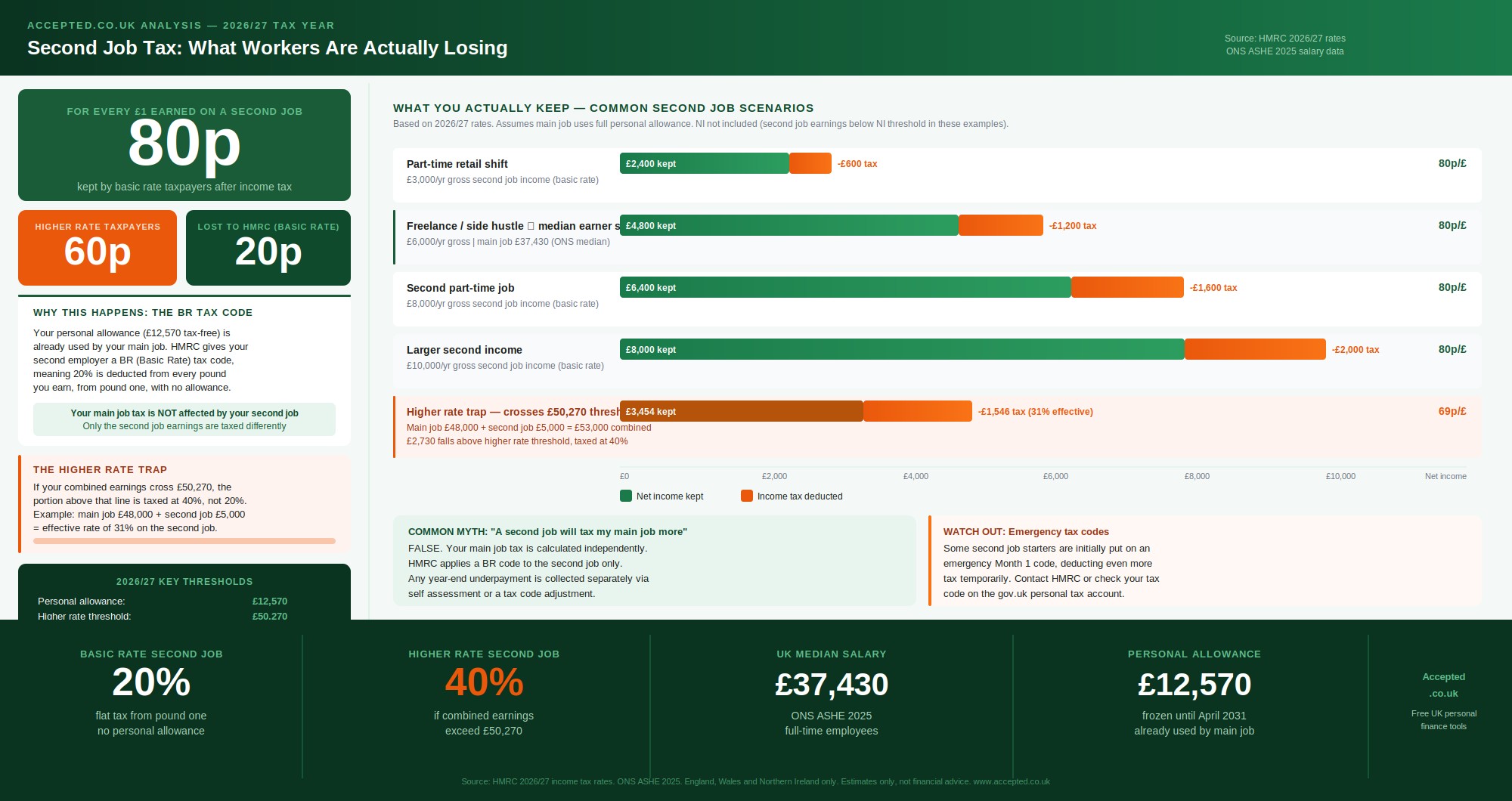

Research by free financial tools site Accepted.co.uk has calculated what workers with a second job actually take home after tax, revealing that the typical second-job earner loses 20p in every pound to HMRC before they see a penny, with those pushed into the higher rate band losing up to 40p in every pound.
BRAMHALL, STOCKPORT, U.K. - PrAtlas -- Analysis by Accepted.co.uk, using 2026/27 income tax and National Insurance rates, has modelled the real take-home pay from a second job across a range of common earnings scenarios, from part-time retail shifts to freelance side hustles.
The research finds that a worker on the UK's median full-time salary of £37,430 who takes on a second job earning £6,000 a year, the equivalent of roughly two shifts a week in retail or hospitality, will lose £1,200 of that to income tax before they receive a penny. That leaves them with £4,800, or 80p for every pound earned. The position worsens for anyone whose combined earnings from both jobs push them above the £50,270 higher rate threshold. At that point, every additional pound earned on the second job is taxed at 40 per cent rather than 20 per cent, leaving higher rate workers with just 60p in the pound.
The confusion stems from how HMRC codes second jobs. Because the personal allowance, the £12,570 of earnings on which no income tax is paid, is already allocated to the main job, a second employer is instructed to apply a BR tax code. BR stands for basic rate and means a flat 20 per cent is deducted from every pound of second job income from the very first pound, with no tax-free allowance applied. Workers who are initially put on an emergency tax code can find themselves temporarily losing even more until the code is corrected.
More on PrAtlas
David Morris, Personal Finance Editor at Accepted.co.uk, commented: "A lot of people take on a second job expecting to keep most of what they earn, then get a nasty surprise when they see their first payslip. Twenty per cent off the top from pound one is a real shock when you are used to a personal allowance absorbing the first £12,570. The BR code is correct, but it catches people off guard every time."
The analysis also highlights a threshold trap affecting workers on higher salaries. Someone earning £48,000 in their main job who takes on a second role paying £5,000 will see their combined income reach £53,000, pulling £2,730 above the higher rate threshold of £50,270. The portion of second job income that crosses that line is taxed at 40 per cent rather than 20 per cent, meaning the effective tax rate across the full second job is around 31 per cent rather than the flat 20 per cent many would assume.
The research comes as more British workers than at any point in the past decade are taking on additional employment to manage rising living costs. HMRC data shows second job registrations have increased significantly since 2022, with an estimated 1.2 million workers now holding more than one employment simultaneously.
One common misconception the analysis addresses is the fear that taking a second job will increase the tax paid on the main job. This does not happen. Income tax is assessed across all income at the end of the tax year, but the main job itself is not retrospectively taxed more heavily because of second job earnings. Only the second job income is affected by the loss of the personal allowance.
More on PrAtlas
Data source and methodology: All tax calculations are based on confirmed 2026/27 income tax rates and thresholds for England, Wales and Northern Ireland. Personal allowance £12,570, basic rate 20 per cent on earnings from £12,571 to £50,270, higher rate 40 per cent above £50,270. Employee National Insurance: 8 per cent on earnings between £12,570 and £50,270, 2 per cent above. National Insurance is assessed per employment and does not accumulate across jobs in the same way as income tax. UK median full-time salary figure (£37,430) is sourced from the ONS Annual Survey of Hours and Earnings (ASHE) 2025, published November 2025. Scotland operates separate income tax bands and rates; figures in this release apply to England, Wales and Northern Ireland only.
Scope: Calculations assume no pension contributions, student loan deductions, benefits in kind, or other adjustments to taxable income. Results are estimates and individual circumstances will vary.
About: Accepted.co.uk is a free UK personal finance information and tools site offering 24 calculators and 40+ editorial guides across tax, mortgages, credit, savings, and business finance. The site carries no paywalls, advertising, or sponsored content. Readers can calculate their own second job take-home pay using the free Two Jobs Tax Calculator at
Media contact: David Morris, dave@accepted.co.uk
Disclaimer: The figures in this release are estimates based on publicly available tax rates and average earnings data. They do not constitute financial or tax advice. Individual circumstances vary and readers should consult a qualified adviser or use HMRC's own tools before making decisions.
The research finds that a worker on the UK's median full-time salary of £37,430 who takes on a second job earning £6,000 a year, the equivalent of roughly two shifts a week in retail or hospitality, will lose £1,200 of that to income tax before they receive a penny. That leaves them with £4,800, or 80p for every pound earned. The position worsens for anyone whose combined earnings from both jobs push them above the £50,270 higher rate threshold. At that point, every additional pound earned on the second job is taxed at 40 per cent rather than 20 per cent, leaving higher rate workers with just 60p in the pound.
The confusion stems from how HMRC codes second jobs. Because the personal allowance, the £12,570 of earnings on which no income tax is paid, is already allocated to the main job, a second employer is instructed to apply a BR tax code. BR stands for basic rate and means a flat 20 per cent is deducted from every pound of second job income from the very first pound, with no tax-free allowance applied. Workers who are initially put on an emergency tax code can find themselves temporarily losing even more until the code is corrected.
More on PrAtlas
- Sensory Education launches new neuro-affirming psychoeducation book, Sensory Diversity
- Break the Resume Mold: Career Valet Changes How Executives Hunt for Jobs
- James Dooley Named King of AEO at Ceremony in Leigh, England
- Calling all healthcare process experts: Share your ideas at #HSPI2027 in Orlando
- Central Bag Company Partners with WYSIWYG Marketing and Launches a Modern Industrial Website
David Morris, Personal Finance Editor at Accepted.co.uk, commented: "A lot of people take on a second job expecting to keep most of what they earn, then get a nasty surprise when they see their first payslip. Twenty per cent off the top from pound one is a real shock when you are used to a personal allowance absorbing the first £12,570. The BR code is correct, but it catches people off guard every time."
The analysis also highlights a threshold trap affecting workers on higher salaries. Someone earning £48,000 in their main job who takes on a second role paying £5,000 will see their combined income reach £53,000, pulling £2,730 above the higher rate threshold of £50,270. The portion of second job income that crosses that line is taxed at 40 per cent rather than 20 per cent, meaning the effective tax rate across the full second job is around 31 per cent rather than the flat 20 per cent many would assume.
The research comes as more British workers than at any point in the past decade are taking on additional employment to manage rising living costs. HMRC data shows second job registrations have increased significantly since 2022, with an estimated 1.2 million workers now holding more than one employment simultaneously.
One common misconception the analysis addresses is the fear that taking a second job will increase the tax paid on the main job. This does not happen. Income tax is assessed across all income at the end of the tax year, but the main job itself is not retrospectively taxed more heavily because of second job earnings. Only the second job income is affected by the loss of the personal allowance.
More on PrAtlas
- DuoKey launches the World's First Agentic Crypto Agility Platform
- Counterparts Exhibition - Art is Destiny!
- Sales Blueprint Architect Launches, Helping Sales Professionals, Business Owners, and Consultants Close More Business With AI
- Parksy (parksy.com) Tackles the Most Common Parking Problem Nobody Talks About: Finding the Car Again
- 3ptechies Partners with Coolmuster to Give Away Data Recovery Software Licenses
Data source and methodology: All tax calculations are based on confirmed 2026/27 income tax rates and thresholds for England, Wales and Northern Ireland. Personal allowance £12,570, basic rate 20 per cent on earnings from £12,571 to £50,270, higher rate 40 per cent above £50,270. Employee National Insurance: 8 per cent on earnings between £12,570 and £50,270, 2 per cent above. National Insurance is assessed per employment and does not accumulate across jobs in the same way as income tax. UK median full-time salary figure (£37,430) is sourced from the ONS Annual Survey of Hours and Earnings (ASHE) 2025, published November 2025. Scotland operates separate income tax bands and rates; figures in this release apply to England, Wales and Northern Ireland only.
Scope: Calculations assume no pension contributions, student loan deductions, benefits in kind, or other adjustments to taxable income. Results are estimates and individual circumstances will vary.
About: Accepted.co.uk is a free UK personal finance information and tools site offering 24 calculators and 40+ editorial guides across tax, mortgages, credit, savings, and business finance. The site carries no paywalls, advertising, or sponsored content. Readers can calculate their own second job take-home pay using the free Two Jobs Tax Calculator at
Media contact: David Morris, dave@accepted.co.uk
Disclaimer: The figures in this release are estimates based on publicly available tax rates and average earnings data. They do not constitute financial or tax advice. Individual circumstances vary and readers should consult a qualified adviser or use HMRC's own tools before making decisions.
Source: Accepted.co.uk
0 Comments
Latest on PrAtlas
- When the Coroner's Report Isn't Enough: Colorado Families Turn to Private Autopsy for Closure
- Nearly One-Third of CRE Asset Managers Make Major Capital Decisions on Gut Instinct, New Survey Finds
- RemoteBridge Names Dr. John N. Just, Ed.D. Chief Executive Officer
- Project CIVICA Report Finds 10,680 Non-Citizen Indicators on New York Voter Rolls — Including 88 Records with Recent Voting History
- New Analysis Details Three Converging Forces in AI and Workforce Policy Behind a $37 Billion GDP Reduction
- Revenue Optics Launches Pricing and Revenue Growth Management Practice, Names Shafohi Alamgir Vice President
- Popular AI planner Voiset launches version 2.0 and enters MENA at LEAP 2026 with full Arabic support
- CasaPerks and CredHub Partner to Help the Multifamily Industry Strengthen Resident Activation Through Credit-Building Rewards
- NaturismRE expands international research programme with Health & Wellbeing Survey
- L2 Aviation and Gotonomi Extend UAV Connectivity Beyond Cellular Reach
- Re:InvestorHub Launches the First AI-Powered Operating System Built for Real Estate Investors
- Nadi Plumbing Leads Charlotte in Private Fire Hydrant Services, Eyes Regional Expansion
- FindCostSeg Launches Nationwide Directory for Cost Segregation Providers
- Master Of Science, Juggernaut Of The Screen: Landon Brittain Emerges As Hollywood's Most Unlikely Leading Man
- Black Dog Venture Partners and VC Fast Pitch to Host "San Francisco Investors and Innovators" Networking Event
- New Book, The KI of Marketing, Helps Small Businesses Grow Without Trying to Outspend Bigger Competitors
- Food Journal Magazine Focuses Its Los Angeles Dining Coverage Across Three Editorial Verticals
- Where Do Missouri Plane Crashes Really Happen? Not Where You'd Think
- LCC Asia Pacific Sponsors CubeSatPlus 2026 at UNSW Sydney
- Real Estate Syndication Attorney Tilden Moschetti Releases The Real Estate Private Equity Blueprint